“We don’t cross borders. Borders cross us.”
We heard it again and again in Ciudad Juárez, from people whose lives have been split apart by a line on a map. As Rafael Jesús, the City of Berkeley’s first poet laureate and a participant in the Peace Summit, put it even more simply: “Maps lie.”
From September 18 to 20, Global Exchange and the People’s Movement for Peace and Justice brought together more than 250 people representing over 100 organizations from Mexico, the United States, and Canada for the 2026 Binational Peace Summit, to confront the lies that divide us and defend the truths that connect us.
Mothers searching for their disappeared children. Survivors of armed violence. Indigenous and Afro-descendant leaders. Migrants, day laborers, and union organizers. Communities fighting mega-projects on their lands.
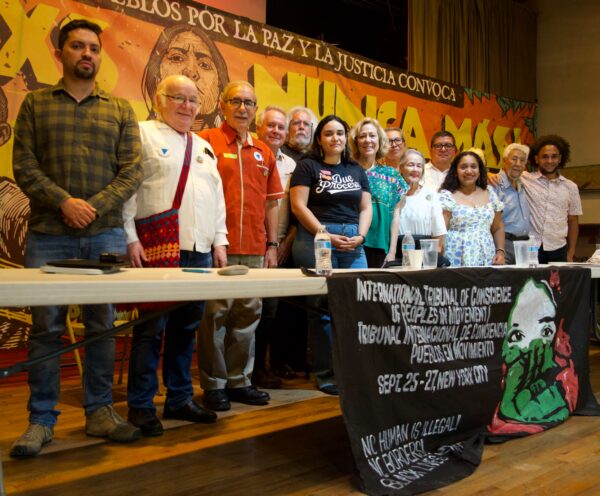
We began the Summit by recognizing the pain and grief that millions of people have carried over the past several years. We thanked one another and created a space to receive care and solidarity from those gathered around us.
Then we got to work.
On day one, for more than eight hours, a People’s Jury of 17 lawyers, advocates, and movement leaders heard testimony describing the devastating impacts of authoritarianism, racism, and armed violence. On day two, we discussed how to organize an unprecedented front for life, peace, and justice.
As Marco Castillo, Co-Executive Director of Global Exchange and a founding member of the People’s Movement for Peace and Justice, told the room:
“This space isn’t about competing agendas. It’s about building a new majority that is respectful, empathetic, and loving toward the identity of others, and at the same time committed to solving problems and finding common ground.”
The testimony showed just how connected our struggles are across borders.
“When we talk about armed violence and disappearance, we’re not talking about two separate phenomena,” said Diana Gutierrez, who has been searching for her disappeared mother. “We’re talking about one chain: arms trafficking from the United States, firepower in Mexico, territorial control, disappearance, clandestine mass graves…”
At the end of the Summit, the Tribunal presented its conclusions, calling on governments to close immigration detention centers; respect the rights to free movement, asylum, and refuge; end arms trafficking; and address the human rights violations documented through the testimony.
“Their crimes know no borders, and neither do our rights,” the jury declared in its closing statement.
And as one participant reminded us, “Peace is not limited to seeking the absence of armed conflict. It requires historical socio-environmental justice, comprehensive territorial reparations, an end to structural racism…”
The Summit closed with an emotional ceremony at the Ciudad Juárez border levee beside the Puente Negro—the “Black Bridge” that physically links our two countries.

Participants planted ten white crosses bearing demands and remembrances, from “NO ICE” to “Ayotzinapa,” honoring people taken by immigration enforcement in the United States, the 43 Ayotzinapa students, and the hundreds of thousands of people who have disappeared in Mexico.
We cried. We hugged one another. We planted the crosses as protest songs played across the levee.
As participants began making their way home, Chris Smalls and two Mexican human rights defenders from Derechos Humanos Integrales en Acción (DHIA) were detained by U.S. Customs and Border Protection for more than 12 hours while crossing from Ciudad Juárez into El Paso after attending the Peace Summit.
Summit participants denounced their detention and demanded an end to the harassment and criminalization of activists and human rights defenders. We stand with Chris, with our partners at DHIA, and with every defender targeted for their organizing and human rights work.
Now, participants are back home across Mexico, the United States, and Canada with renewed energy, new allies, and new ideas—and connected through a growing trinational network.
The next steps in our organizing include a Continental Tribunal in Mexico City on October 14 and the presentation of the Tribunal’s final report on December 10, International Human Rights Day.
Governments can inflict pain and take away rights. But they cannot take away our love for one another, for nature, and for peace.
That is our treasure, and one of our most powerful tools.
Hate will never be more powerful than people standing together for peace and justice.