

Our mission
To elevate the voices of international leaders who have defended democracy under threat and share the lessons their experiences offer to communities facing growing pressure on democratic institutions.
Around the world, democracies have come under increasing pressure from authoritarian movements, disinformation campaigns, attacks on independent institutions, and political leaders willing to undermine democratic norms for power.
The Democracy Defenders Roadshow connected U.S. audiences with leaders who had lived through these struggles, not as abstract observers, but as people who had worked to defend democratic systems under pressure. By bringing these voices directly to communities across the country, the Roadshow created opportunities to exchange lessons, strategies, and experiences across borders.
Our mission
To elevate the voices of international leaders who have defended democracy under threat and share the lessons their experiences offer to communities facing growing pressure on democratic institutions.
Our vision
A world where democratic societies learn from one another, strengthen civic participation, resist authoritarianism, and protect the institutions and communities that sustain democracy.
The Democracy Defenders Roadshow was presented by Global Exchange, an international human rights organization that has spent more than three decades building people-to-people connections to advance democracy, justice, and human rights around the world. Since 1988, Global Exchange has worked alongside grassroots movements in the United States, Latin America, and beyond to strengthen civic participation, defend human rights, and connect local struggles to broader movements for justice.
The Roadshow brought democracy defenders from Latin America into direct conversation with communities across the United States. Over 15 stops in 11 states, speakers and participants exchanged lessons on civic participation, authoritarianism, racial justice, migration, gun violence, journalism, misinformation, reparations, peacebuilding, immigrant organizing, and the role communities play in sustaining democratic life.
Several themes emerged again and again. Democracy is practiced every day, not only during elections. It grows through neighborhood organizing, schools, workplaces, houses of worship, community institutions, mutual aid, independent media, and the relationships that allow people to act together. Trustworthy information is also essential to democratic power. Communities need journalists, organizers, educators, and advocates who are willing to document abuses, challenge misinformation, preserve memory, and help people understand the forces shaping their lives.
The Roadshow also showed how deeply connected these struggles are across borders. Conversations about migration led to questions about U.S. foreign policy. Discussions of gun violence in the United States connected to the flow of U.S. firearms into Mexico. Reparations work in Chicago opened onto broader movements for racial justice across the Americas. Across every stop, participants saw how violence, inequality, political exclusion, and concentrated power can take different forms while producing shared challenges.
Just as important, the exchange moved in both directions. The Roadshow speakers brought experiences from Guatemala, Colombia, Honduras, and Mexico, while communities across the United States shared their own strategies for organizing, mutual aid, independent journalism, civic education, labor rights, immigrant support, and coalition-building. The result was a network of relationships grounded in a simple idea: no community has all the answers, and no community has to face these challenges alone.

Lucía Vijil is a researcher and defender of Honduran democracy affiliated with the Center for the Study of Democracy (CESPAD). She has coordinated and analyzed the CESPAD–Youth Electoral Platform Election Observation Mission during the 2021 and 2025 general elections, developing methodologies for continuous monitoring, assessment of institutional risks, and technical oversight of polling station closure, vote counting, and vote traceability. Her work has helped document structural failures, political pressures, and operational weaknesses that affect public trust, electoral transparency, and democratic legitimacy in contexts of high institutional fragility. Her strategic approach links electoral integrity, socio-territorial conflict, and democratic governance. She analyzes how institutional capture, structural inequality, and conflicts over land and natural resources directly affect the exercise of voting rights and political stability. From this perspective, she advances research and coordination with civil society aimed at strengthening accountability, protecting civic space, and contributing rigorous evidence for democratic reconstruction in Honduras and the region.

Mynor Alonzo is a political analyst, strategist, and co-founder of FOCO, a Guatemalan social research organization. With a trajectory that began in student activism at the University of San Carlos (USAC), the country’s only public university, and in the creation of the democratic observatory Chalán (www.chalanusac.org), his work brings together rigorous political analysis and civic organizing. Through FOCO, Mynor fosters spaces for critical reflection to translate the country’s complex current context into strategic tools. His work connects the demands of historically marginalized communities with national debates on social justice and transparency, providing them with tools to influence decision-making and strengthen democratic resilience in Guatemala.

Alí Bantú Ashanti is a lawyer, human rights defender, and strategist in high-impact litigation involving state crimes. He is the founder of Colectivo Justicia Racial, a network of lawyers and humanists dedicated to dismantling structural racism in Colombia. Born in Timbiquí, Cauca, a historically marginalized territory in Colombia’s Pacific region, his legal work is deeply rooted in community experience. He advocates for abolitionism and reforms in justice, drug policy, and security. He has led strategic litigation related to police and military violence, as well as the defense of people unjustly convicted by the justice system. His work has placed special emphasis on the mobilization, organization, and defense of the internationally and constitutionally recognized rights of Afro-descendant peoples. Beyond the courts, Bantú Ashanti promotes grassroots organizing campaigns to strengthen Afro-descendant political representation, develop youth leadership, and connect local struggles with international human rights frameworks. His work brings together legal defense, movement strategy, and global solidarity, placing racial justice at the center of democratic reform in Latin America.

Elena Gutierrez is affiliated with Global Exchange in Mexico and collaborates with the People’s Movement for Peace and Justice to advance community-based peacebuilding initiatives and strengthen international solidarity networks. Her work focuses on building cross-border alliances that connect local organizing efforts with broader advocacy platforms. She has accompanied dialogue processes, community organizing strategies, and coordination efforts among movements aimed at promoting nonviolence, accountability, and democratic participation. Her work links grassroots organizing with international solidarity frameworks, reinforcing the importance of collective action beyond national borders. Through this collaboration, she contributes to strengthening regional networks committed to human rights, social justice, and democratic resilience.

Ernesto Ledesma is an investigative journalist and founder of Rompeviento TV, an independent digital platform dedicated to human rights journalism, democratic accountability, and analysis of social movements in Mexico. His journalistic work has addressed issues such as corruption, state violence, socio-environmental conflicts, and community resistance. Rompeviento has established itself as an independent voice that amplifies civil society perspectives often marginalized in mainstream media. Ledesma’s work positions journalism as a democratic safeguard, essential for exposing abuses of power and defending freedom of expression. Through rigorous investigations and multimedia storytelling, he contributes to public debate on transparency, state accountability, and citizen oversight in Mexico’s changing democratic landscape.

Dayana Mosquera is a Global Exchange consultant in Colombia whose work analyzes the intersection of United States foreign policy, international security frameworks, and their impact on Colombian civil society. Her research focuses on how external political and economic pressures influence internal democratic processes, particularly in contexts marked by armed conflict transitions and electoral volatility. She has collaborated with grassroots organizations, peacebuilding initiatives, and regional advocacy networks, helping build bridges between local and international actors. Her work examines patterns of political violence, threats against social leaders, and the challenges of implementing peace agreements in contexts of institutional fragility. Through policy analysis, public education, and the coordination of delegations, Mosquera plays an important role in strengthening alliances between Colombian civil society actors and advocacy networks in the United States. Her work helps translate local realities into international conversations on accountability, democracy, and human rights.

Alberto Solís Castro is a peacebuilder and human rights specialist now working with Global Exchange, where he brings more than two decades of experience in conflict transformation and civic accompaniment. He previously served as Executive Director of Serapaz (Servicios y Asesoría para la Paz), the organization founded in 1996 by Bishop Samuel Ruiz García to support mediation in the armed conflict between the EZLN and the Mexican government, the same peace process that shaped Ernesto Ledesma's early career in Chiapas. Over his career he has coordinated more than 80 conflict-transformation processes, accompanying movements organized around land rights, justice for the disappeared, indigenous autonomy, and democratic accountability. He holds degrees in Political Science and Public Administration from UNAM and teaches History and New Paradigms of Peace at the University of the Cloister of Sor Juana in Mexico City.

Omar Gómez Trejo is a Mexican human rights lawyer internationally recognized for his work as Special Prosecutor in the Ayotzinapa case in Mexico, one of the most emblematic forced disappearance cases in contemporary Latin America. His leadership in reopening and restructuring the investigation challenged previously established official narratives and confronted institutional obstruction within state structures. Under his direction, investigative efforts focused on forensic truth, victim-centered justice, and dismantling the so-called “historical truth” that had protected impunity. Omar has more than 20 years of experience working in the United States, Mexico, and Central America. He has worked for the Inter-American Commission on Human Rights, the Office of the United Nations High Commissioner for Human Rights, and international and Mexican organizations on complex cases.

Coalición de Líderes Latinos
This is a space for reflection and analysis on the challenges and opportunities facing Hispanic migrant communities in the Georgia region with regard to voting, with an eye toward the midterm elections in November 2026. Our focus is on the Latino communities located in the Dalton region.
View Details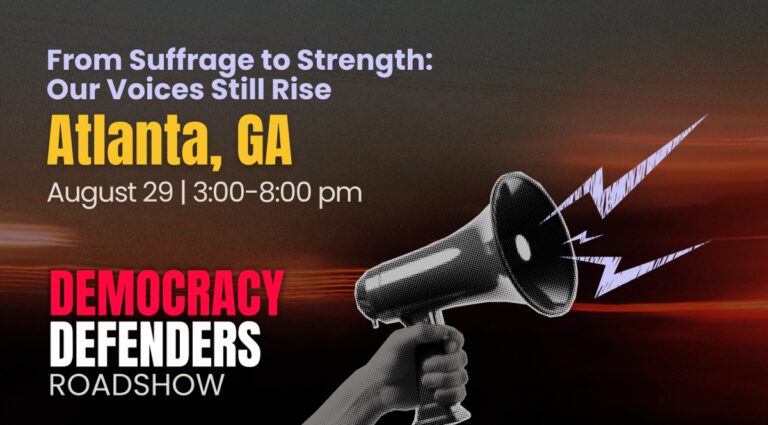
Hotel Indigo Atlanta
“From Suffrage to Strength: Our Voices Still Rise” aims to commemorate women’s right to vote, incorporating global perspectives, recognizing the ongoing international struggle to defend democracy and protect women’s rights.
View Details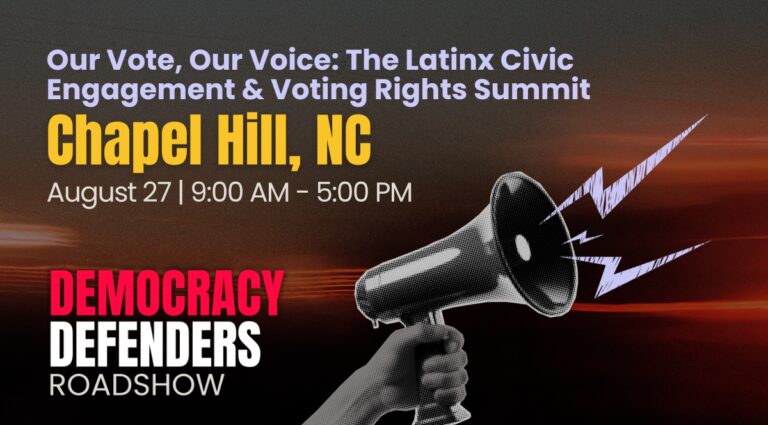
United Church of Chapel Hill
LILA Latinx LGBTQI+ will bring together the vibrant Latinx community and Allies of Durham and the Triangle for a powerful one-day convening rooted in one simple truth: your vote is your voice, and your voice matters.
View Details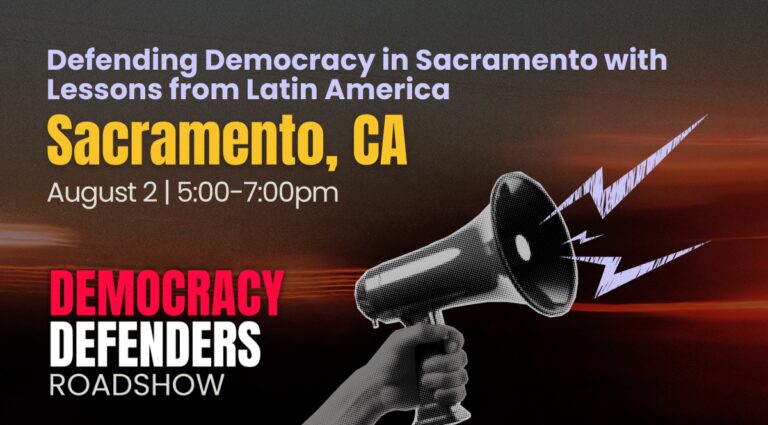
CWA Local 9421
In the United States today, attacks on the integrity of elections have become routine. People have lost trust in official sources of information and a political divide is developing beyond values and policy into different worlds of truth. We can learn from the experience of our neighbors to the south who have long dealt with instability of democratic institutions, corruption, and repression of civic and labor organizations. Visiting Sacramento are three prominent Latin American leaders, here to exchange stories and inspire action as part of the nationwide Democracy Defenders Roadshow.
View Details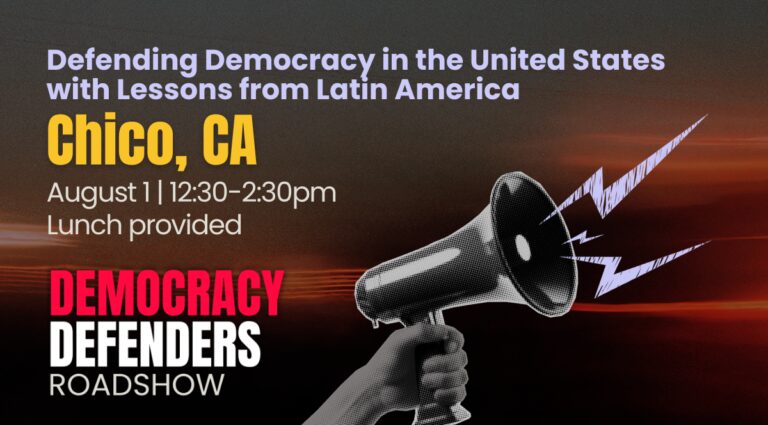
Chico State Behavioral and Social Sciences Building 101
In the United States today, attacks on the integrity of elections have become routine. People have lost trust in official sources of information and a political divide is developing beyond values and policy into different worlds of truth. We can learn from the experience of our neighbors to the south who have long dealt with instability of democratic institutions, corruption, and repression. Visiting Chico are three prominent Latin American civic leaders, here to exchange stories and inspire action as part of the nationwide Democracy Defenders Roadshow.
View Details
Recorded sessions, conversations, and future event replays will live here once the first resources are ready.

Stories of Resistance is a new podcast featuring vignettes pulled from journalist Michael Fox’s 20 years of interviews, research, and reporting from across the Americas. Co-produced by Global Exchange and The Real News Network , each week we’ll bring you stories that remind us of the struggles that have come before, and the ones we are living now. Inspiration for dark times.

A timely conversation uniting movements at borders to confront the “iron flow” of weapons from the United States that is fueling violence in communities around the world.
**PANELISTS:
John Lindsay-Poland, Stop US Arms to Mexico
Christina Delgado, National Coordinator of Organization, Community Justice
Ben Dooley, Reporter, ICIJ
Grace Fernández, Movement for Our Disappeared, Mexico
Sergio Aguayo, Professor, El Colegio de México

As U.S. military escalation, economic warfare, and media narratives converge, communities across Latin America are once again being forced to pay the price. This webinar brings together voices from the region to unpack what’s at stake, challenge dominant narratives, and discuss paths forward rooted in solidarity and resistance.
Panelists:
Alex Sierra (CESJUL, Colombia)
Ernesto Ledesma (Rompeviento.tv, Mexico)
Francesca Emanuele (CEPR)
Moderated by: Dayana Mosquera (Global Exchange)

Meet Alí Bantú Ashanti, a Colombian lawyer and human rights defender, and strategist in high-impact litigation involving state crimes. Born in Timbiqui, Colombia, Alí founded Justicia Racial, an organization defending victims from state crimes and injustices. Alí underlines the importance to stand up against global fascism, the injustices that come from it, and the decay of democracy.

Meet Ernesto Ledesma, an investigative journalist and founder of Rompeviento TV, an independent digital platform, dedicated to human rights, journalism, democratic, accountability, and analysis of social movements in Mexico. Ernesto was involved in humanitarian aid flotilla operations for Palestine and Cuba, and speaks about his experiences with mutual aid and calls for solidarity and allyship to defend democracy and bring mutual aid to those vulnerable to atrocities.

Meet Lucía Vijil, a researcher and defender of Hondorian democracy, affiliated with the Center for the Study of Democracy (CESPAD). She discusses the 2009 Honduran Coup and how the extractive model of capitalism globally has negatively impacted the environment, community, and resources in Honduras since.


