Global Exchange Mexico News
August 2025

Global Exchange’s Peace and Justice program with Mexico has been deeply rooted since 1994 and is growing again now in 2025. As part of our mission of cross-border collaboration, we are sending this English-language newsletter that features selected articles, action alerts, video reports, analysis, social movement news, and volunteer opportunities. Your feedback and suggestions are welcome. Feel free to contact us at: Mexico@globalexchange.org
This issue focuses on Chiapas, specifically addressing recent attacks on the leadership of the Fray Bartolomé Human Rights Center.

The Fray Bartolomé Human Rights Center is Once Again Under Attack
Update and Action Request

Last July 22, in the middle of the night, the home of Dora Roblero, the newly appointed Director of the Fray Bartolomé Human Rights Center (Frayba) in San Cristóbal de las Casas, was targeted and invaded.

This chilling attack on the new leader of the state’s pre-eminent human rights group is anything but an isolated incident. The break-in comes in the context of surging violence and intimidation from criminal and paramilitary actors whose activities Frayba has been documenting for over a decade.


Please sign this petition to Mexico’s President, Cabinet officers, and heads of agencies in charge of security policy, urging them to respond to the deepening threats and violence facing the communities and human rights defenders of Chiapas.

Please also feel free to share and distribute this petition. It is being circulated by our longtime partners, the National Network of Civil Human Rights Organizations, “All Rights for All,” a coalition of 87 human rights organizations from 23 Mexican states.


What is Frayba? How we know them and why we respect their work

Some background on Frayba and the Zapatista uprising
Pattern of unchecked abuse and government indifference; why we support Frayba today

What is Frayba? How we know them and why we respect their work
The vital work of Frayba began in 1989 when the center was founded by the late Catholic Bishop Don Samuel Ruíz, whose parishioners affectionately called him “Don Sam.” Deeply influenced by the theory and practice of Liberation Theology, Don Samuel professed a revolutionary interpretation of scripture that redefined the essence of Christian life as one of alliance and solidarity with the poor and powerless.

Don Samuel’s approach during his forty years as Bishop (1959–1999) was to actively listen and engage with the realities of his parishioners’ lives.

Under Don Samuel’s leadership in the late 1980s, Frayba began investigating local problems and defending people and communities in need. They helped people falsely jailed, tortured, and even murdered, often for political reasons. They helped Indigenous communities fighting incursions and violent land seizures.

Starting in the 1960s, Don Samuel had insisted that his priests learn local Indigenous languages, and he trained hundreds of Indigenous deacons and catechists who spent years crisscrossing remote canyons, towns, and villages throughout the Lacandon rainforest. Unlike countless generations of their colonial predecessors, these “religious workers” came not to proselytize, but to listen—listen to understand and serve the needs and aspirations of the communities they were part of. This approach, which he called “evangelization by the poor,” led to deep and previously unknown levels of trust and community engagement. As word of these visionary practices spread, “Don Sam” attracted some of Mexico’s brightest minds and most intelligent hearts to the Diocese of San Cristóbal, the leadership of Frayba, and a small but growing contingent of civil society organizations dedicated to community empowerment and transformational development.

This tireless organizing over decades played an important role in fomenting and giving both resilience and a safe communications channel to communities that would later form the living backbone of what the world would come to know as the Zapatista Army of National Liberation (EZLN).


Zapatista Uprising

The EZLN is the group that successfully organized something of a military miracle on January 1, 1994, when thousands of lightly armed, bandana-wearing rural Indigenous men and women swept down overnight—many on foot—from their homes in the highlands. They swiftly captured four municipal capitals and by the end of New Year’s Day were in control of an area approximately the size of El Salvador. That was just the beginning.

The shocked reaction to the uprising was dramatically compounded by its timing on the day the bitterly controversial NAFTA accords went into effect. NAFTA, designed by and for “North American elites,” was negotiated between Mexico’s (Harvard-educated) president, Salinas de Gortari, and American (Yale-educated) President George H.W. Bush and subsequently embraced, ratified, and signed by President (“I feel your pain,” but also Yale-educated) Bill Clinton.

Now, the uprising by some of Mexico’s most marginalized people put their whole bipartisan “neo-liberal” project at risk of being exposed as the dangerous fraud—“It will improve the quality of life in all three member countries”—that it always was.

Then came the communiqués—and a mysterious, powerful, and even lyrical voice from the Lacandon Forest in Mexico’s extreme southeast corner that framed the uprising as an Indigenous-led “rebellion against extinction” and called on the rest of Mexico to join them in rebelling.

The response across Mexico was electric and immediate. Even as the Mexican Army closed in on and began slaughtering retreating rebels, people talked, organized, and on January 12 more than 100,000 Mexicans poured into Mexico City’s Zócalo to demand an immediate ceasefire and peace negotiations.

Behind the scenes, Don Samuel Ruíz and his brilliant team sought to convince the authorities to avert the kind of full-scale genocide committed in neighboring Guatemala just a decade before. Don Samuel was painfully aware of what happened just across the border when Guatemalan military rulers unleashed the army on Indigenous rebels, killing and displacing hundreds of thousands of people and—just between 1981 and 1983—obliterating 440 Mayan villages.

In the face of growing public pressure across Mexico and around the world, the Salinas de Gortari government declared a ceasefire and halted its deadly advance into rebel communities. But the conflict was by no means over. The Army kept its troops in forward positions—establishing a multi-year siege that controlled access to Indigenous communities—rebel, “Zapatista,” and even unaligned—forcing residents to routinely submit to inspection at military checkpoints where they could be harassed, summarily detained, or worse.

In the tumultuous months and years that followed, millions of Mexicans mobilized, demonstrated, and sent donations to support the bold and articulate rebels in Chiapas. The rebel Zapatista communities invited like-minded organizers from around Mexico to a series of huge gatherings in their remote territories—where big ideas and dreams for Mexico’s liberation were hatched and took flight throughout the 1990s. But the Army didn’t go away, and in response, Frayba organized a remarkably ambitious, successful, and sustained non-violent community defense project that maintained a permanent (rotating) presence of volunteer “peace campers” in nearly 50 remote communities 24/7/365 for eight years. Their job was to accompany the communities and report on any abuses from Army occupiers. Maintaining the training and flow of thousands of these willing volunteers was a massive undertaking that was supported by organizations across Mexico and beyond.

In its early years, Global Exchange’s Mexico Program played a humble support role in this vast collective accompaniment—by recruiting, preparing, and housing a small but steady flow of Peace Camp volunteers throughout all the years of military occupation.


Pattern of Unchecked Abuse and Government Indifference; Why We Support Frayba Now

A lot has changed in Mexico in the last 25 years, in ways big and small, but some things have remained the same—such as the Fray Bartolomé Human Rights Center’s defense of threatened Indigenous communities. That is why Frayba was attacked in the 1990s and why it is under attack now. But the context is different.

Today’s attacks no longer come at the hands of the occupying Federal Army and the irregular (PRI-affiliated) paramilitary organizations aligned with them. Rather, most of the 16,755 cases of recent displacement documented by Frayba have been at the hands of competing crime syndicates such as the Sinaloa Cartel and the Cártel de Jalisco Nueva Generación, as well as a proliferation of smaller criminal actors trying to gain traction in these rural zones. Adding to this toxic volatility are new paramilitary actors such as the Pakales, who have intimidated dissidents and broken up protests.

Please take another look at this petition to Mexico’s President, Cabinet officers, and heads of agencies in charge of security policy that we also shared above.

It is extremely important that the government take these concerns seriously. They need to respond, investigate, and act on behalf of these communities that are unable to defend themselves against criminals with sophisticated arms. For years, Global Exchange has heard from human rights activists across Mexico who are deeply concerned that the government is not giving sufficient attention to threats like the ones still growing in Chiapas.

Thanks, and until next time.

P.S. The struggle for human rights in Chiapas is part of a broader movement.
Frayba’s call for protection is urgent, but it is not isolated. The struggle for peace and justice in Cherán and Ostula is also ongoing—and deeply connected to a larger system of militarization, state violence, and resource extraction that crosses borders.

Add your name in support of Cherán’s demands for safety, peace, and justice as outlined in their public statements. Sign here.

Support legislation like the ARMAS Act to stop the flow of U.S. weapons fueling violence in places like Chiapas, Cherán, and Ostula.

Take action for Frayba today—sign the petition demanding protection for Dora Roblero and the Frayba team.
Frayba Petition.

Together, these actions are part of one fight: for dignity, self-determination, and justice across the Americas.

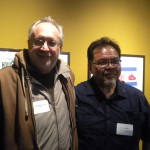
Javier Sicilia with Juan Mora, from DePaul University in Chicago

Javier Sicilia’s message to the audiences of four public events in Chicago, IL was clear and powerful;

In 1994 subcomandante Marcos introduced the Zapatistas to the world, declaring Mexican President Salinas’ signing of NAFTA opened ‘the gates of hell’ for Mexico, and now Mexico is living in that hell.

He begins every speech quoting terrifying statistics: Since 2006, there are 60,000 Mexicans dead, 20,000 Mexicans disappeared and 250,000 Mexicans displaced from their homes, all a result of a drug war launched by a deaf and dumb government. And there is no end in sight. More than 98% of homicides committed in Mexico are never resolved. He brings home the message that if anyone in the audience decided to kill someone in Mexico, there would be less than 2% chance of ever being held accountable.

The cost of the war reflected in these numbers has grown inexorably since last year when the respected poet announced to an adoring Mexican public that he was putting aside his poetry to protest the government’s complicity with organized crime and inexcusable inaction in investigating the deaths of those killed in drug war related violence.

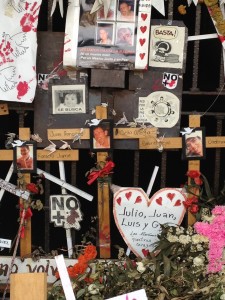
Altar outside of the Municipal Palace in Cuernavaca Morelos, with names and pictures of drug war related victims

Javier’s son Juan Francisco was murdered along with six friends on a fateful night in March of 2011 in Temixco, Morelos. Suddenly, Javier –who had long been active in Mexico’s cultural and political life — became the voice for a movement led by people who are simply called ‘las victimas’.

He is emphatic that the statistics don’t convey the real picture. He says that the face of the person who suffered ‘one death’ or ‘one disappearance’ is one person who had a character, a personality and merits justice. One death represents a family torn apart in grief. The fact that more than 98% of the time those seeking answers from authorities get no satisfaction adds to their pain and misery. One disappeared person represents a family consumed with fear and unanswered questions. One displaced family lives in constant upheaval and suffering. In short, the statistics are overwhelming but even one is too many.

The public events were co-sponsored by the National Museum of Mexican Art, UIC (Latin American and Latino Studies Program), DePaul University and The Resurrection Project and well attended by students, activists and members of the Latino community in Chicago. In each speech Javier repeated the urgent demands of the Mexico-based Movement for Peace with Justice and Dignity – the organization of victims that came together last year to declare Estámos hasta la Madre/We Are Fed Up (with the drug war) – to the Mexican and US governments. The Pacto Nacional (link in Spanish) was signed May 12, 2011 with the following demands:

  • End the drug war, a failure of tragic proportions;
  • End the easy access to high-powered weapons that facilitates weapons smuggling;
  • Crack down on those who help criminal enterprises by laundering money;
  • Defend the human security and dignity of immigrants;
  • End US support for the militarization of Mexico.

In Mexico, the Movement for Peace with Justice and Dignity is campaigning for approval of the Ley de Victimas this week. This law would place new responsibility on the government to investigate drug war related crimes and provides a fund for impacted families.

Carrying the voices of las victimas to the United States, Javier is widening the Movement for Peace with Justice and Dignity’s profile and building support for a US Peace Caravan this summer (link in Spanish). Javier and the Caravan will cross the United States in cars, buses, and RVs joined by victims of drug war related violence from Mexico, supporters, activists and journalists. The Caravan will stop at key cities along the route for public conferences, demonstrations and meetings with key local leaders.

TAKE ACTION!

  • For more information about Javier Sicilia’s speaking events in the USA, click here.
  • For more information about the US Peace Caravan, click here.

The following was written by Laura Carlsen and originally appeared in the Americas MexicoBlog on January 25th.

It was a remarkable mass for a remarkable man.

The news spread rapidly yesterday morning of the death of Bishop Samuel Ruiz. He died at the age of 86, the day that marked 51 years since his ordination as Bishop of the Diocese of San Cristobal. By 2:30 the Mexico City church had filled with an unusual group of religious leaders, peace activists and figures who have marked Mexican politics over the years. All recalled their work alongside Tatik (“father” in Tzeltal) with a bittersweet blend of loss and gratitude.

I sat in the pews, listening to the first strains of “métale a la marcha, métale al tambor, métale que traigo un pueblo en mi voz…” (Join the march, join the drum, join in, I carry the people in my voice…) watching the faces of hundreds of committed people who in various moments of a long and full life walked alongside Don Sam, El caminante. A history that changed Mexico forever flooded into the room.

Bishop Raúl Vera recalled that Samuel Ruiz arrived in the state of Chiapas to face a reality he had not imagined, a reality that many in Mexico didn’t know existed. He set out to travel to the far corners of the region– not an easy task–and saw with his own eyes the scars of the plantation-owners’ whips on the backs of indigenous men and heard the accounts of how young girls were routinely forced to have their virginity “tested” (lost) by the owners when they decided to marry, among other terrible examples of the feudal conditions his new parishioners suffered. He encountered a system of oppression and brutality that changed his life and he decided the system had to change, through the word of God and an intense social commitment.

It’s worth mentioning that Bishop Raúl Vera came to know his counterpart when the Church sent him as a “coadjutor” to Ruiz in 1995, presumably to temper his radical influence. The opposite happened. In what Vera describes as a conversion experience, he encountered the conditions that had led Don Samuel to embrace a church of and for the poor and soon became a partner in bringing the church down to the people and building a movement to allow its indigenous members to gain their rightful place in the church and in society. To this day, Don Raúl remains as a successor to the work of Don Samuel; now based in Coahuila, his is a strong voice in defense of a human rights as Mexico suffers a new phase of violence and repression.

Next, Father Heriberto Cruz recounted that the reflection among some members of the church, initiated in large part by Don Samuel and his experience in Chiapas in those early days, did not just center on the traditional concern of how the church could alleviate the burden of its members. Ruiz and others began to ask themselves what role the church itself played in their oppression and how to break that oppression. A deep critique of the role of traditional methods of evangelization in suppressing indigenous culture followed. Ruiz learned to speak Tzotzil and Tzeltal and became conversant with  other indigenous languages of the region. He insisted on respect for indigenous cultures–another factor that would bring him into conflict with some elements of the Church that criticized what they viewed as the excessive syncretism of his theology and practices.

Don Samuel Ruiz formed part of and led a movement within the Roman Catholic Church that based its theology on the Vatican II commitment to greater lay participation, the “option for the poor” that shifted attention to the need to serve the historically downtrodden, and the idea that the church cannot ignore injustice without being complicit.

These would become the principles he acted on.  As mediator in the Zapatista indigenous uprising of 1994, Ruiz helped create the conditions for the new indigenous movement that marked not only Mexico but the world. His work as leader of the National Mediation Commission (CONAI) led to an unprecedented dialogue that resulted in the San Andrés Accords on Indigenous Rights and Culture, signed and later violated by the federal government. The Accords stand as a tribute to his work and the work of scores of indigenous leaders. They also stand as a tragic reminder that the word of the powerful cannot be trusted. But the spirit of emancipation and peaceful dialogue codified in the Accords survives in the individuals gathered at the mass for Don Samuel Ruiz, one of the principal architects of the peace process, and among the thousands of indigenous people who wait to receive his remains in his beloved state of Chiapas.

Don Samuel insisted that the church of the poor needed a human rights organization in Chiapas faced with the extreme human rights violations taking place. In 1989, he founded the Fray Bartolome de las Casas Center for Human Rights. The Center’s mission is to “walk alongside and at the service of the poor, excluded and organized people who seek to overcome their socioeconomic and political situation, by taking direction and the strength from them to contribute to their project of building a new society where people and communities fully exercise and enjoy their rights.” The mission embodies the strong belief that the church cannot be separated from the struggle for social justice and that it should play a supporting role rather than pronouncing from on high.

These beliefs often put Bishop Ruiz at odds with the powers-that-be in government and in the hierarchy of the Roman Catholic Church. They also made him a target of the local caciques, or rural bosses, that ran Chiapas with a iron hand and lorded over the lives of indigenous peoples. He faced aggressive attacks on his character with magnanimity, and patiently continued to build from below. The Diocese became an example of the leadership role of indigenous peoples in defining a new church and empowering communities and the 1994 Zapatista uprising catapulted his patient labor onto a world stage, as the long-ignored demands of indigenous peoples became the lens through which to conceive of a new society.

There were, of course, efforts to dismantle the deep processes of empowering indigenous people within the church and within society. The Mexican government sent in troops and launched military offenses against the communities well after the truce with the EZLN. Meanwhile, the Vatican began to attack the practice of making indigenous men deacons within the church–a centerpiece of effort to break down the distance between indigenous communities and a distant and privileged hierarchy, to literally change the face of the church. When the Roman Catholic hierarchy decided not to name Bishop Vera to the San Cristobal diocese following the retirement of Don Samuel, which would have been a natural choice but for the politics involved, it was seen as an indication of the desire to suppress the progressive religious movement in Chiapas. More recently a plan to divide the San Cristobal diocese has led to suspicions that the hierarchy seeks to weaken Mexico’s only diocese guided by the Second Vatican Council’s decision to promote a closer relationship to the social and political context of parish members.

There was a deep sense of loss among the those attending the mass, but few tears. Over the years, many people feared that Don Samuel would become a martyr rather than die a natural death. He received death threats and created enemies among those who abhorred the idea of a church that championed the rights of the poor and indigenous peoples, since their own power and wealth rested on preserving near-slavery conditions. Bishop Ruiz accepted the risk to his own life. His death at 86 ended a journey on earth that was consistent and effective in following his convictions and that touched and inspired thousands of people who will carry on. The liturgy on Monday did not dwell on the loss, but rather emphasized the meaning of his life and the Catholic belief that he passed into a higher realm.

Bishop Samuel Ruiz’s remains have been sent to San Cristobal, Chiapas to be buried in the Cathedral. Surely he will be welcomed there by the indigenous people he walked alongside over the years. Some fifteen thousand indigenous people came down from the mountains to bid him farewell in 2000 when Ruiz left Chiapas, in a testament to the relationships he forged and his role in their lives and their movement for liberation.

This final farewell reminds us that Don Samuel’s deep commitment to indigenous rights and social justice is not some folkloric moment in Mexico’s colorful past, nor is his life merely a chapter neatly written into our religious and social history. His is not a legacy. Something that hasn’t died leaves no legacy.

Although many of the people present at his mass have gone on to other battles and fronts, Don Sam’s death is a reminder of the enormous tasks still pending. Bishop Vera began the mass by stating “in these dark times, a star has been lifted.” Somber nods from the congregation–mostly human rights defenders and Catholics who work with the poor–reflected agreement that Mexico faces one of the worst moments in recent history for the poor, indigenous and vulnerable, and that Don Sam’s example gives hope and strength.

This reminder brings a renewed sense of responsibility to act. It encourages us to see through the darkness of the times and seek each other out, just as he helped bring together the many diverse individuals that went out to honor him yesterday. The passing of the “Bishop of the Poor” urges us to keep walking the path he cleared and to forge new paths of peace and justice.