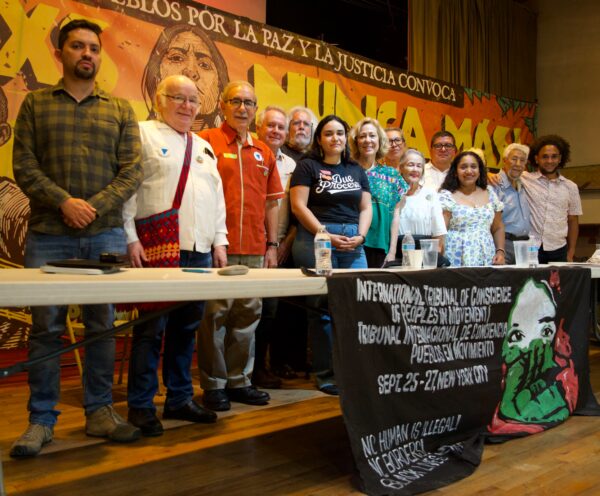
Cumbre binacional en Ciudad Juárez por la paz y la justicia
Activistas de México, Estados Unidos y Canadá se reunieron en la fronteriza Ciudad Juárez para escuchar testimonios sobre las violaciones a los derechos humanos en la región. Un grupo de especialistas recogió las conclusiones de este inusual encuentro para presentarlas a mediados de octubre en una cumbre continental en la Ciudad de México. Kent Paterson asistió al evento y nos presenta este reporte, en la voz de Ruben Tapia.
We heard it again and again in Ciudad Juárez, from people whose lives have been split apart by a line on a map. As Rafael Jesús, the City of Berkeley’s first poet laureate and a participant in the Peace Summit, put it even more simply: “Maps lie.”
From September 18 to 20, Global Exchange and the People’s Movement for Peace and Justice brought together more than 250 people representing over 100 organizations from Mexico, the United States, and Canada for the 2026 Binational Peace Summit, to confront the lies that divide us and defend the truths that connect us.
Mothers searching for their disappeared children. Survivors of armed violence. Indigenous and Afro-descendant leaders. Migrants, day laborers, and union organizers. Communities fighting mega-projects on their lands.
We began the Summit by recognizing the pain and grief that millions of people have carried over the past several years. We thanked one another and created a space to receive care and solidarity from those gathered around us.
Then we got to work.
On day one, for more than eight hours, a People’s Jury of 17 lawyers, advocates, and movement leaders heard testimony describing the devastating impacts of authoritarianism, racism, and armed violence. On day two, we discussed how to organize an unprecedented front for life, peace, and justice.
As Marco Castillo, Co-Executive Director of Global Exchange and a founding member of the People’s Movement for Peace and Justice, told the room:
“This space isn’t about competing agendas. It’s about building a new majority that is respectful, empathetic, and loving toward the identity of others, and at the same time committed to solving problems and finding common ground.”
The testimony showed just how connected our struggles are across borders.
“When we talk about armed violence and disappearance, we’re not talking about two separate phenomena,” said Diana Gutierrez, who has been searching for her disappeared mother. “We’re talking about one chain: arms trafficking from the United States, firepower in Mexico, territorial control, disappearance, clandestine mass graves…”
At the end of the Summit, the Tribunal presented its conclusions, calling on governments to close immigration detention centers; respect the rights to free movement, asylum, and refuge; end arms trafficking; and address the human rights violations documented through the testimony.
“Their crimes know no borders, and neither do our rights,” the jury declared in its closing statement.
And as one participant reminded us, “Peace is not limited to seeking the absence of armed conflict. It requires historical socio-environmental justice, comprehensive territorial reparations, an end to structural racism…”
The Summit closed with an emotional ceremony at the Ciudad Juárez border levee beside the Puente Negro—the “Black Bridge” that physically links our two countries.
Participants planted ten white crosses bearing demands and remembrances, from “NO ICE” to “Ayotzinapa,” honoring people taken by immigration enforcement in the United States, the 43 Ayotzinapa students, and the hundreds of thousands of people who have disappeared in Mexico.
We cried. We hugged one another. We planted the crosses as protest songs played across the levee.
As participants began making their way home, Chris Smalls and two Mexican human rights defenders from Derechos Humanos Integrales en Acción (DHIA) were detained by U.S. Customs and Border Protection for more than 12 hours while crossing from Ciudad Juárez into El Paso after attending the Peace Summit.
Summit participants denounced their detention and demanded an end to the harassment and criminalization of activists and human rights defenders. We stand with Chris, with our partners at DHIA, and with every defender targeted for their organizing and human rights work.
Now, participants are back home across Mexico, the United States, and Canada with renewed energy, new allies, and new ideas—and connected through a growing trinational network.
The next steps in our organizing include a Continental Tribunal in Mexico City on October 14 and the presentation of the Tribunal’s final report on December 10, International Human Rights Day.
Governments can inflict pain and take away rights. But they cannot take away our love for one another, for nature, and for peace.
That is our treasure, and one of our most powerful tools.
Hate will never be more powerful than people standing together for peace and justice.
Democracy is under attack.
Not as a metaphor. Not as a talking point. As a fact, visible right now, in this country, in this moment. Institutions are being dismantled. Courts are being defied. Journalists are being targeted. Communities are living in fear. The rights of millions are being stripped away by executive fiat.
This is not a new story. Across Latin America, civic leaders have watched this pattern before. The consolidation of power. The weaponization of fear. The assault on the independent institutions that make self-governance possible. Many of them fought back. Some of them won.
They have something essential to teach us. And in the spring of 2025, as the full weight of what was unfolding in this country became clear, we went to find them.
On the shores of Lake Atitlán in Guatemala, Global Exchange convened 140 activists, organizers, Indigenous leaders, and democracy defenders from across the Americas for a gathering called Democracies Under Attack: From Crisis to Strategy. We chose Guatemala deliberately. It is a country that knows both the devastation of authoritarianism and the tenacity of people who refuse to be crushed by it. The conversations that happened there were urgent, clear-eyed, and full of hard-won knowledge that most Americans have not yet had access to.
Democracy Defenders Roadshow | June-Sept 2026
Launching in Minneapolis this June, Global Exchange is bringing experienced democracy defenders from across Latin America into direct dialogue with communities throughout the United States. These are not theorists or diplomats. They are civic leaders, journalists, human rights advocates, and community organizers who have defended participation, accountability, and democratic norms under real pressure. And held.
They know how it unfolds. They know what it fears. And they know, because they have done it, that it can be stopped.
From June through September, the Roadshow will travel coast to coast, stopping in communities large and small for public forums, community exchanges, and strategy sessions. The kind of honest, grounded conversations that movements are built from.
There, you can learn more about the Roadshow, explore resources and featured videos from the leaders who will be traveling to the United States, and find upcoming events as registration becomes available.
Featured voices include:
• Lucía Vijil (Honduras) — researcher and defender of Honduran democracy affiliated with CESPAD
• Dayana Mosquera (Colombia) — Global Exchange consultant and policy analyst
• Alí Bantú Ashanti (Colombia) — lawyer, human rights defender, and strategist with Colectivo Justicia Racial
• Ernesto Ledesma (Mexico) — investigative journalist and founder of Rompeviento TV
• Mynor Alonzo (Guatemala) — political analyst, strategist, and co-founder of FOCO
• Elena Gutiérrez (Mexico) — Global Exchange Mexico-US Program Director
• Alberto Solís Castro (Mexico) — Peacebuilder and human rights specialist
• Omar Gómez (Mexico) — Human rights lawyer
Watch the Meet the Defenders videos
We are excited to share a new video series where each speaker introduces themselves, their regional context, and the work they are bringing to the Roadshow.
Meet the defenders and watch all the videos here. If the Roadshow is coming to your area, we invite you to sign up and join us. If you know people in one of the communities we will be visiting, please share the event with them. These conversations are meant to travel through relationships, networks, and communities of people who understand what is at stake.
We will also be sharing updates, speaker content, event announcements, and reflections from the road through Global Exchange’s social media channels.
Here is what we know: democracy does not defend itself. We defend it, together, in community, through relationships built across every line that power tries to draw between us.
The people joining us this summer have already proven that. They stood up when it was costly. They built coalitions when it felt impossible. They protected the vote, the press, the courts, the streets. And they held.
Now it is our turn. And we do not have to start from zero.
We are looking for host partners who want to bring this conversation to their community. Civic organizations, universities, faith communities, worker and immigrant groups, coalitions working on democratic participation, human rights, or community safety.
Democracy is under attack. The defenders are mobilizing. Join us.