Cumbre binacional en Ciudad Juárez por la paz y la justicia
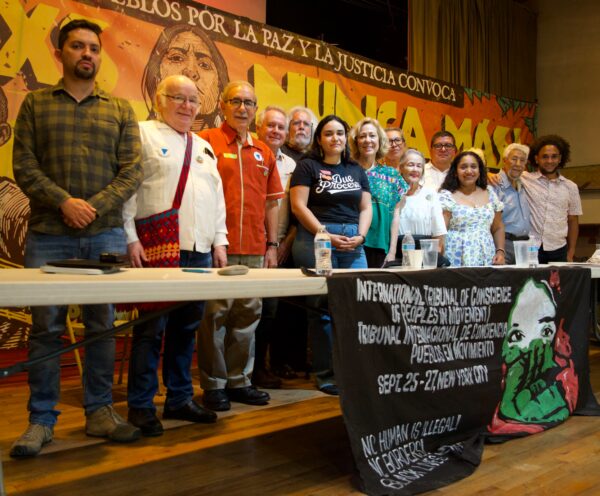
Activistas de México, Estados Unidos y Canadá se reunieron en la fronteriza Ciudad Juárez para escuchar testimonios sobre las violaciones a los derechos humanos en la región. Un grupo de especialistas recogió las conclusiones de este inusual encuentro para presentarlas a mediados de octubre en una cumbre continental en la Ciudad de México. Kent Paterson asistió al evento y nos presenta este reporte, en la voz de Ruben Tapia.
We heard it again and again in Ciudad Juárez, from people whose lives have been split apart by a line on a map. As Rafael Jesús, the City of Berkeley’s first poet laureate and a participant in the Peace Summit, put it even more simply: “Maps lie.”
From September 18 to 20, Global Exchange and the People’s Movement for Peace and Justice brought together more than 250 people representing over 100 organizations from Mexico, the United States, and Canada for the 2026 Binational Peace Summit, to confront the lies that divide us and defend the truths that connect us.
Mothers searching for their disappeared children. Survivors of armed violence. Indigenous and Afro-descendant leaders. Migrants, day laborers, and union organizers. Communities fighting mega-projects on their lands.
We began the Summit by recognizing the pain and grief that millions of people have carried over the past several years. We thanked one another and created a space to receive care and solidarity from those gathered around us.
Then we got to work.
On day one, for more than eight hours, a People’s Jury of 17 lawyers, advocates, and movement leaders heard testimony describing the devastating impacts of authoritarianism, racism, and armed violence. On day two, we discussed how to organize an unprecedented front for life, peace, and justice.
As Marco Castillo, Co-Executive Director of Global Exchange and a founding member of the People’s Movement for Peace and Justice, told the room:
“This space isn’t about competing agendas. It’s about building a new majority that is respectful, empathetic, and loving toward the identity of others, and at the same time committed to solving problems and finding common ground.”
The testimony showed just how connected our struggles are across borders.
“When we talk about armed violence and disappearance, we’re not talking about two separate phenomena,” said Diana Gutierrez, who has been searching for her disappeared mother. “We’re talking about one chain: arms trafficking from the United States, firepower in Mexico, territorial control, disappearance, clandestine mass graves…”
At the end of the Summit, the Tribunal presented its conclusions, calling on governments to close immigration detention centers; respect the rights to free movement, asylum, and refuge; end arms trafficking; and address the human rights violations documented through the testimony.
“Their crimes know no borders, and neither do our rights,” the jury declared in its closing statement.
And as one participant reminded us, “Peace is not limited to seeking the absence of armed conflict. It requires historical socio-environmental justice, comprehensive territorial reparations, an end to structural racism…”
The Summit closed with an emotional ceremony at the Ciudad Juárez border levee beside the Puente Negro—the “Black Bridge” that physically links our two countries.
Participants planted ten white crosses bearing demands and remembrances, from “NO ICE” to “Ayotzinapa,” honoring people taken by immigration enforcement in the United States, the 43 Ayotzinapa students, and the hundreds of thousands of people who have disappeared in Mexico.
We cried. We hugged one another. We planted the crosses as protest songs played across the levee.
As participants began making their way home, Chris Smalls and two Mexican human rights defenders from Derechos Humanos Integrales en Acción (DHIA) were detained by U.S. Customs and Border Protection for more than 12 hours while crossing from Ciudad Juárez into El Paso after attending the Peace Summit.
Summit participants denounced their detention and demanded an end to the harassment and criminalization of activists and human rights defenders. We stand with Chris, with our partners at DHIA, and with every defender targeted for their organizing and human rights work.
Now, participants are back home across Mexico, the United States, and Canada with renewed energy, new allies, and new ideas—and connected through a growing trinational network.
The next steps in our organizing include a Continental Tribunal in Mexico City on October 14 and the presentation of the Tribunal’s final report on December 10, International Human Rights Day.
Governments can inflict pain and take away rights. But they cannot take away our love for one another, for nature, and for peace.
That is our treasure, and one of our most powerful tools.
Hate will never be more powerful than people standing together for peace and justice.
Trump’s proposed version of NAFTA falls far short of the long held demands of the labor, environmental, and human rights communities. This webinar is an important opportunity to provide our movement with information about the impact that NAFTA has had and how Trump’s NAFTA could continue to harm working people and the environment in all three countries. It will also provide grassroots activists with context and talking points for contacting their member of congress and offer ways to get involved in the fight against Trump’s pro-corporate NAFTA.
FEATURED PRESENTERS:
* Will Wiltschko, Director, California Trade Justice Coalition (moderator)
* Selden Prentice, Trade and Climate Activist, 350 Seattle
* David Bacon, Photojournalist and Activist
* Hannah Lyon, Cancer Families for Affordable Medicine
Within the coming months, Congress will decide whether or not Trump’s NAFTA deal is passed in its current form. The next 60 days will be critical to pressure Congress to either fix the NAFTA proposal by reopening the texts to remove the dangerous provisions on pharmaceuticals and add enforcement mechanisms, or keep it from coming to a vote if the Trump administration refuses to allow changes to the deal.
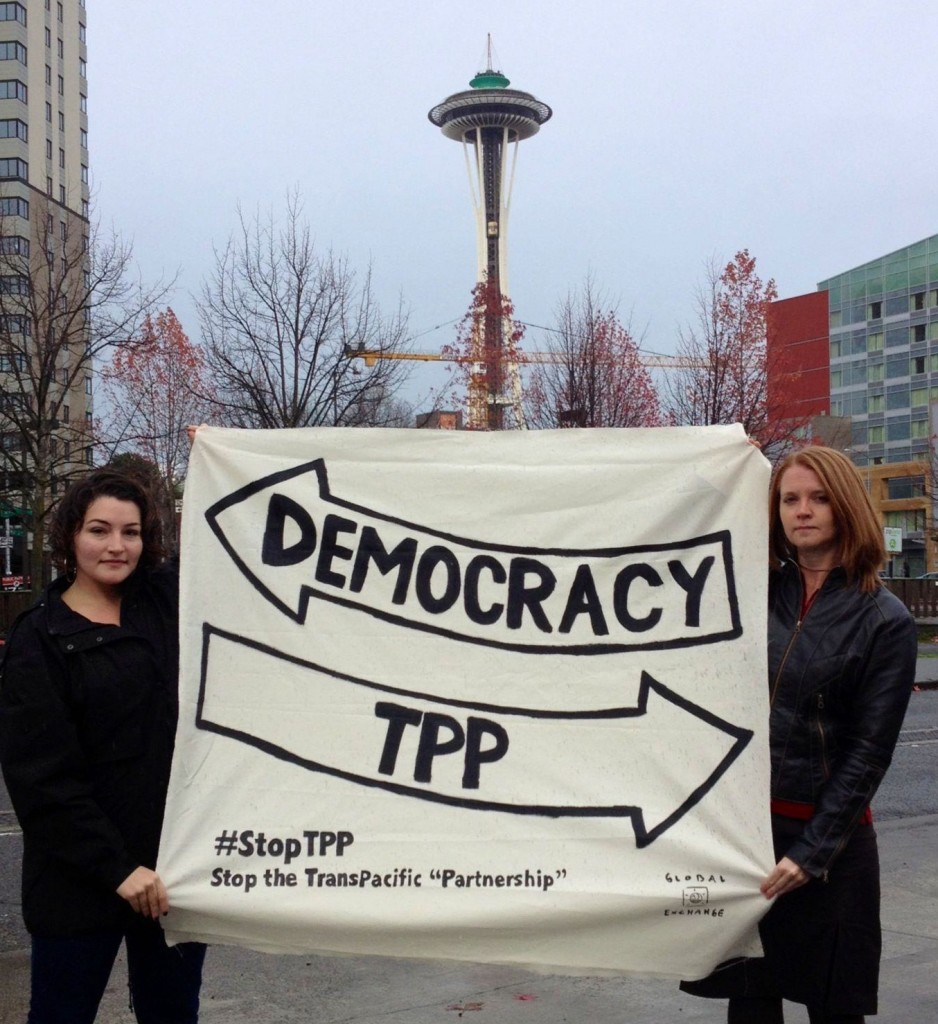
Exactly 13 years after the #N30 actions to shut down the WTO, Global Exchange returns to Seattle with a similar message: #StopTPP!
We all know free trade agreements are politically, economically, and environmentally harmful.
But this weekend at TPPxBorder, hearing people speak to the real consequences of these deals brought my understanding of the dangers of these Free Trade Agreements (FTAs) to a very human scale.
Listening to the voices of people who are affected by these FTAs – a pulp mill worker from Everett, WA, who got laid off two years before pension, HIV positive people who won’t be able to afford life-saving medication because of patent laws that protect profits instead of access, a Philippine woman who was forced to leave her family in search of work – these voices remind me that free trade isn’t just an ‘issue’ to discuss or debate. Free trade is about about profits at the expense of people’s health and safely. About trade over ethics. About politics over people and planet.
Free trade ‘agreements’ are anything but consensual.
In fact, the only partnering happening in the TransPacific ‘Partnership’ is is the stitching together of the 1%- corporations and politicians- whilst the entirety of civil society is excluded and ignored… for now.
Jill Mangaliman, Philippine U.S. Solidarity Organization pusoseattle.wordpress.com/
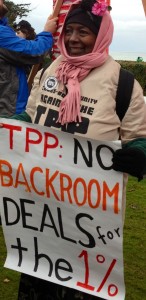
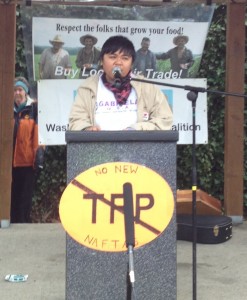
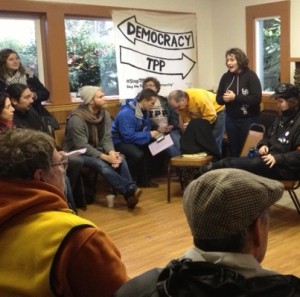
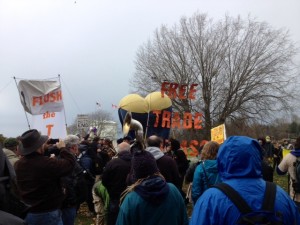
We called this one TPPxBorder: The People’s Round. What I loved about this rally wasn’t only the fiery speakers, the diversity, the music, the unity, the hot coffee, and the ultra-legitimacy of our opposition to this heinous version of the TPP…. what I loved was learning about what an alternative deal would look like- one by and for the people. Listening to speakers and experts articulately describe what fair trade looks like, what it offers communities internationally, reminds me why these fights are so important, and the promise of real, practical, and respectful trade solutions. We have answers – now is the time to join hands and fight for them.
After our rally, and piñata action (in which people managed to overcome ‘blindfolds’ of corporate greenwashing and lobbyist money to finally destroy the TPP piñata and release the affordable jellybean ‘medicines’ and GMO-free popcorn trapped inside!) we headed indoors to a warm meal and strategy sessions to plan future action.
Global Exchange & Witness for Peace co-led a “Social Media to #StopTPP” breakout group to discuss “Twitterstorming” the corporations secretly negotiating TPP.
The breakout group I co-lead was about how we can use social media to #StopTPP. Our strategy is to call out the corporations negotiating the TPP in secret… and put their secrets in public view on social media channels. This week, our coalition members are calling out two corporate interests a day on their ties to the TPP… would you like to join the Twitterstorm? Just follow @GlobalExchange and @ElectDemocracy on Twitter, then retweet our actions every day this week at 11am and 2pmPST to help spread the word about #StopTPP using the very follower lists that these corporations have built. We can use your help and you can participate from anywhere.
The TransPacific Partnership is on a 1%-gilded beltway and it’s moving fast. But there is time (and enough of us) to stop it. The first thing we all can do is help spread the word. None of us can afford another NAFTA. Help us get the last 250,000 signatures needed this year to reach 1 million on the Avaaz petition against the TPP! And ask your organization to sign the Unity Statement.
For more information about the TransPacific Partnership and what you can do to stop it, see “10 Reasons to Oppose the TPP.” Thank you for supporting Fair Trade this holiday season, and telling corporations negotiating the TPP in secret exactly what you think of them. Together, we can#StopTPP.
That’s right folks, the sign says “Free Trade, my Ass!”