Cumbre binacional en Ciudad Juárez por la paz y la justicia
Activistas de México, Estados Unidos y Canadá se reunieron en la fronteriza Ciudad Juárez para escuchar testimonios sobre las violaciones a los derechos humanos en la región. Un grupo de especialistas recogió las conclusiones de este inusual encuentro para presentarlas a mediados de octubre en una cumbre continental en la Ciudad de México. Kent Paterson asistió al evento y nos presenta este reporte, en la voz de Ruben Tapia.
We heard it again and again in Ciudad Juárez, from people whose lives have been split apart by a line on a map. As Rafael Jesús, the City of Berkeley’s first poet laureate and a participant in the Peace Summit, put it even more simply: “Maps lie.”
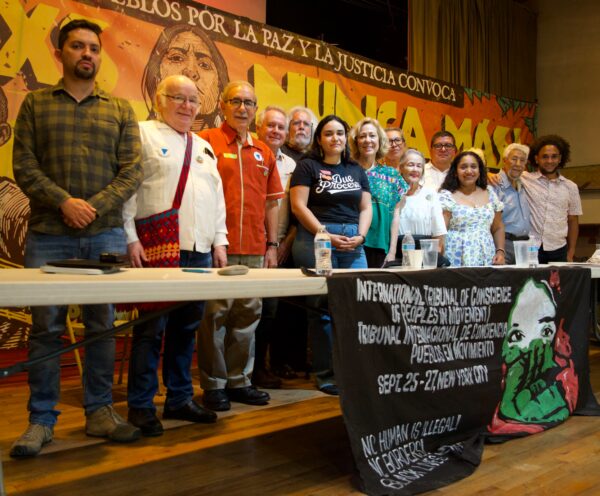
From September 18 to 20, Global Exchange and the People’s Movement for Peace and Justice brought together more than 250 people representing over 100 organizations from Mexico, the United States, and Canada for the 2026 Binational Peace Summit, to confront the lies that divide us and defend the truths that connect us.
Mothers searching for their disappeared children. Survivors of armed violence. Indigenous and Afro-descendant leaders. Migrants, day laborers, and union organizers. Communities fighting mega-projects on their lands.
We began the Summit by recognizing the pain and grief that millions of people have carried over the past several years. We thanked one another and created a space to receive care and solidarity from those gathered around us.
Then we got to work.
On day one, for more than eight hours, a People’s Jury of 17 lawyers, advocates, and movement leaders heard testimony describing the devastating impacts of authoritarianism, racism, and armed violence. On day two, we discussed how to organize an unprecedented front for life, peace, and justice.
As Marco Castillo, Co-Executive Director of Global Exchange and a founding member of the People’s Movement for Peace and Justice, told the room:
“This space isn’t about competing agendas. It’s about building a new majority that is respectful, empathetic, and loving toward the identity of others, and at the same time committed to solving problems and finding common ground.”
The testimony showed just how connected our struggles are across borders.
“When we talk about armed violence and disappearance, we’re not talking about two separate phenomena,” said Diana Gutierrez, who has been searching for her disappeared mother. “We’re talking about one chain: arms trafficking from the United States, firepower in Mexico, territorial control, disappearance, clandestine mass graves…”
At the end of the Summit, the Tribunal presented its conclusions, calling on governments to close immigration detention centers; respect the rights to free movement, asylum, and refuge; end arms trafficking; and address the human rights violations documented through the testimony.
“Their crimes know no borders, and neither do our rights,” the jury declared in its closing statement.
And as one participant reminded us, “Peace is not limited to seeking the absence of armed conflict. It requires historical socio-environmental justice, comprehensive territorial reparations, an end to structural racism…”
The Summit closed with an emotional ceremony at the Ciudad Juárez border levee beside the Puente Negro—the “Black Bridge” that physically links our two countries.
Participants planted ten white crosses bearing demands and remembrances, from “NO ICE” to “Ayotzinapa,” honoring people taken by immigration enforcement in the United States, the 43 Ayotzinapa students, and the hundreds of thousands of people who have disappeared in Mexico.
We cried. We hugged one another. We planted the crosses as protest songs played across the levee.
As participants began making their way home, Chris Smalls and two Mexican human rights defenders from Derechos Humanos Integrales en Acción (DHIA) were detained by U.S. Customs and Border Protection for more than 12 hours while crossing from Ciudad Juárez into El Paso after attending the Peace Summit.
Summit participants denounced their detention and demanded an end to the harassment and criminalization of activists and human rights defenders. We stand with Chris, with our partners at DHIA, and with every defender targeted for their organizing and human rights work.
Now, participants are back home across Mexico, the United States, and Canada with renewed energy, new allies, and new ideas—and connected through a growing trinational network.
The next steps in our organizing include a Continental Tribunal in Mexico City on October 14 and the presentation of the Tribunal’s final report on December 10, International Human Rights Day.
Governments can inflict pain and take away rights. But they cannot take away our love for one another, for nature, and for peace.
That is our treasure, and one of our most powerful tools.
Hate will never be more powerful than people standing together for peace and justice.
The Democracy Defenders Roadshow continued last week in South Bend, Indiana, with a powerful gathering rooted in Black movements, reparations, and solidarity across the Americas.
On July 2, our delegation joined Black Lives Matter South Bend at the St. Joseph County Public Library for “Democracy in Black: Reparations, Repair, and Black Movements Across the Americas.” The event created space for a deep conversation about how democracy, racial justice, and material repair are connected, not only in the United States, but across the hemisphere.
Before the evening program even began, the group appeared together on WUBS 89.7FM, South Bend’s historic Black-owned community radio station, for a bilingual broadcast that helped reach the city’s Latino community. Despite record-breaking heat, the day was full of energy, connection, and purpose.
Jorden Giger opened the evening by connecting the Roadshow’s different stops and the shared struggles communities are facing across borders. Ted Lewis then offered an overview of the Roadshow and Global Exchange’s work to bring frontline democracy defenders into conversation with communities in the United States.
The panel featured moving reflections from Colombia, Mexico, and Guatemala. Alí Bantú Ashanti spoke about his work with Colectivo Justicia Racial, his racial justice collective in Colombia, and connected the fight against fascism and white supremacy to the concrete conditions communities need to survive and thrive, including access to potable water. Turning to the audience, he asked a question that captured the spirit of the evening:“Will you struggle with me?”
Elena Gutierrez spoke about the long struggle of Afro-descendant communities in Mexico to achieve formal recognition, a struggle rooted in centuries of history, marked by hard-won gains, and still far from complete.
Mynor Alonzo shared lessons from Indigenous communities in Guatemala that have built their own governance structures outside the formal political system, including community leadership models that address conflict, administer services, and protect the natural environment. His reflections offered a powerful reminder that democracy is not one fixed model, and that communities often create the systems they need when official structures fail them.
One of the most striking moments of the evening came during the Q&A, when Alí reflected on white supremacy as part of a broader global struggle. Drawing on Malcolm X’s evolving internationalist vision, he reminded the room that the fight against white supremacy is not separate from the fight for all oppressed people everywhere. It is the same struggle, and it cannot be won in isolation.
South Bend showed what the Roadshow is making possible: honest conversations across communities, histories, and borders; lessons grounded in lived experience; and a growing commitment to defend democracy by confronting the systems that deny people dignity, safety, and self-determination.
You can learn more about the roadshow, speakers, and upcoming events hereand make sure to follow us on social media @globalexchange for updates and footage from the events.